An idea is only the starting point of product development. Turning it into a viable product requires a structured process for identifying a market need, evaluating possible solutions, testing assumptions, and learning after launch. This guide explains the six stages of the product development process and offers practical techniques for moving from idea generation to post-launch iteration while reducing avoidable risk.
The Product Development Cycle
The product development cycle is a structured framework for turning ideas into products that can deliver value to customers and the business. Although teams may adapt or revisit individual stages, the cycle creates clear decision points for research, concept evaluation, prototyping, validation, launch, and continuous improvement. This shared structure helps teams surface risks early and make evidence-based product decisions.
Product Development vs. Product Management
Product development and product management are closely related but distinct. Product development is the cross-functional work of researching, designing, building, testing, and launching a product. Product management guides the product’s direction across its lifecycle by defining priorities, aligning stakeholders, and balancing customer needs with business goals. Product managers often coordinate the development process, but successful delivery also depends on design, engineering, marketing, sales, operations, and other teams.
The Six Stages of Product Development
Stage 1: Idea Generation
Idea generation is the first stage of the new product development process. Strong product ideas begin with a clearly understood customer problem or unmet need rather than a solution in search of a market. Teams can find opportunities through customer interviews, market research, support feedback, competitor analysis, emerging technology, and recurring problems in existing products.
Ideation unfolds in multiple stages, commencing with innovation and culminating in actualization. Here are some idea-generation techniques used at this stage:
Brainstorming: Unleashes a torrent of ideas, initially free of evaluation, followed by a careful review to select the finest.
Reverse Brainstorming: Flips the problem-solving script by generating solutions for issues at their core, addressing the root cause.


Idea Mapping: Transforms brainstormed ideas into visual maps using graphical designs, diagrams, and drawings to enhance comprehension and development.
SCAMPER: Utilizes seven concepts - Substitute, Combine, Adapt, Modify, Put to other uses, Eliminate, and Reverse - to prompt inventive problem-solving.

Five “Whys”: The “Five Whys” method dives deep into issues by repeatedly asking “why” to unearth the root cause and devise appropriate solutions.

Stage 2: Concept Development and Evaluation
After identifying a promising idea, define the product concept and evaluate the market, customer problem, value proposition, and delivery constraints. Use interviews, surveys, concept tests, and secondary research to validate assumptions before committing significant resources. The objective is not simply to confirm the idea, but to gather evidence that helps the team refine, reposition, or stop it.
Product Research: Evaluating how the product concept resonates with the market to gauge its development potential.
Risk Analysis: Learning from past hazards in similar product or process development and applying these lessons to minimize future risks.
Customer Analysis: Understanding the target audience’s motivations and needs.
Competitor Analysis: Evaluating market dynamics, including market share, costs, pros, cons, benefits, drawbacks, strengths, and customer feedback on competing products.
Audience Research: Engaging in surveys to identify potential customers among a chosen group of individuals.
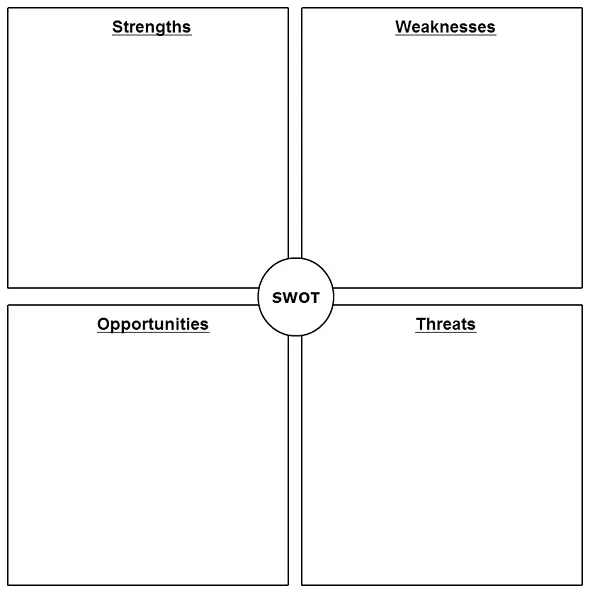
SWOT Analysis: Identifying strengths, weaknesses, opportunities, and threats inherent in the market and product.
Marketplace Data: Assessing retail pricing and supply-demand dynamics.
Market Trends: Studying changes in customer behavior, technology, regulations, and competing solutions that may affect demand or product viability.
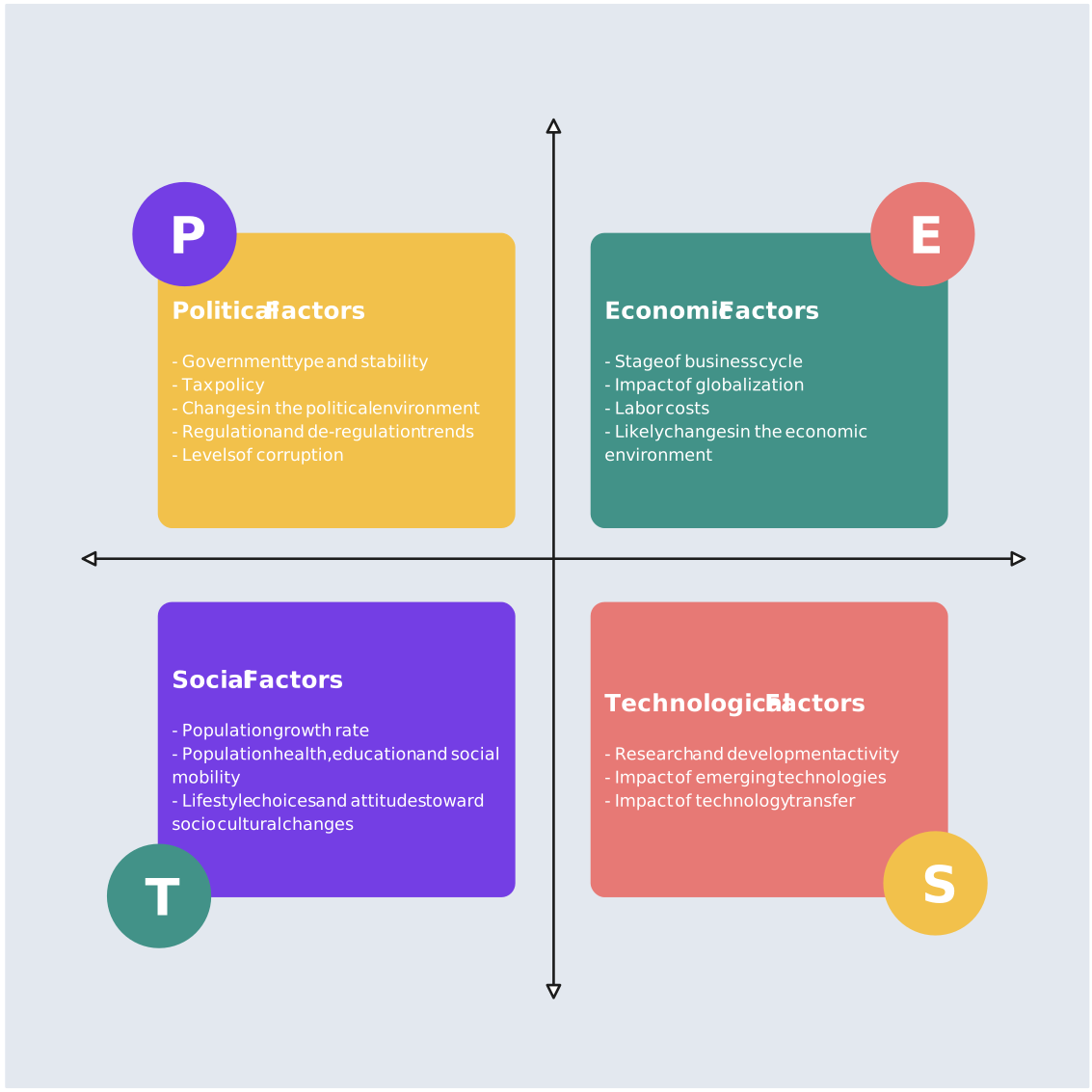
PEST Analysis: Exploring political, economic, social, and technological factors shaping product sustainability in the market.
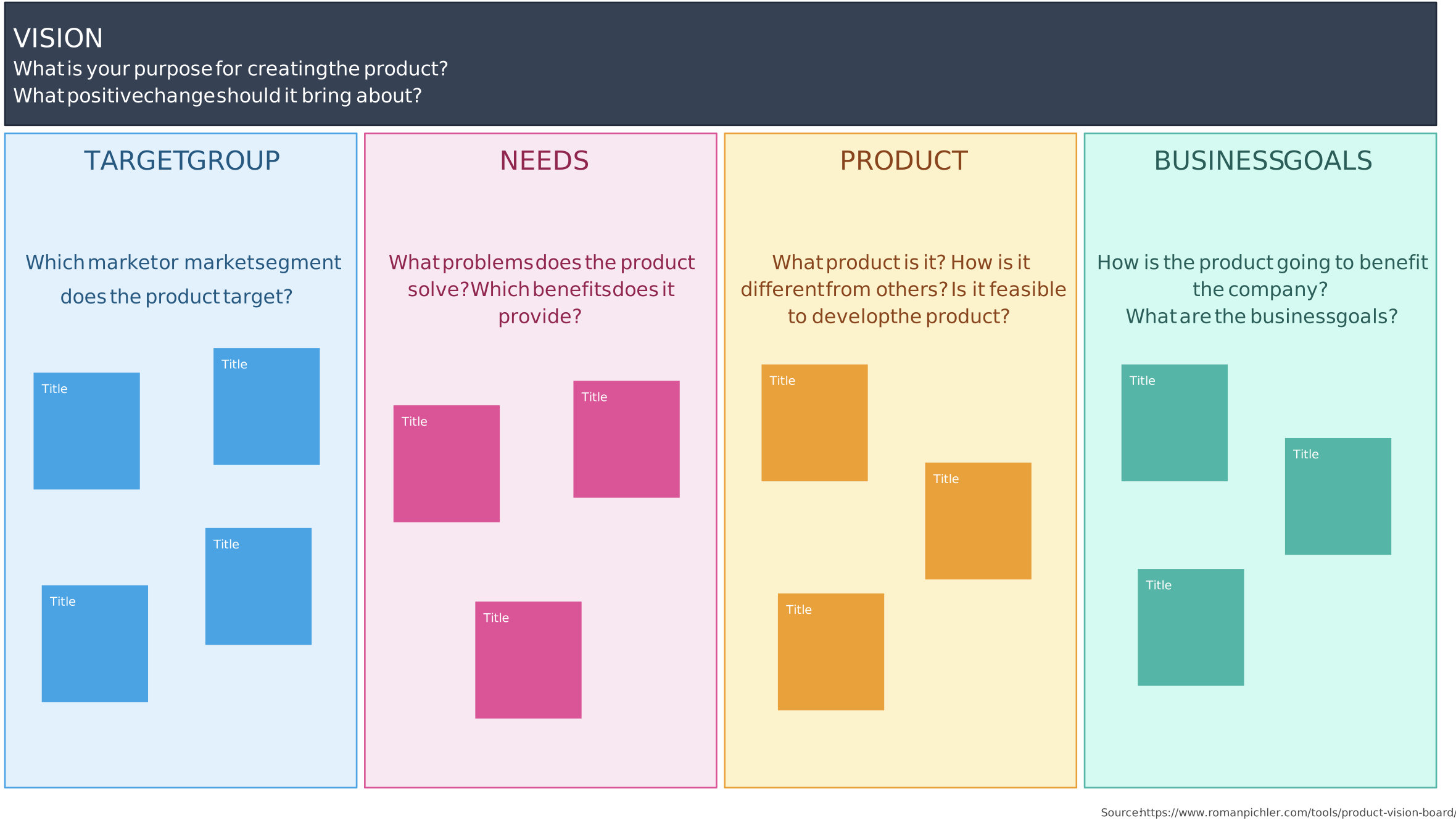
In this phase, refine the product concept and document its target users, problem statement, goals, requirements, constraints, and success measures. A product requirements document (PRD) can capture this shared direction, while feasibility assessments help determine whether the concept is desirable, viable, and technically achievable.
A visual product development process can also clarify who owns each decision, where work passes between research, design, engineering, marketing, and operations, and what evidence supports the next stage. With Creately’s process management workspace, teams can map these handoffs, add owners and structured process details, connect relevant notes, links, and files, and discuss changes through comments and real-time collaboration. Keeping that context connected to the process makes the map a living reference that teams can review and update as the product evolves.
Stage 3: Design and Development of a Prototype
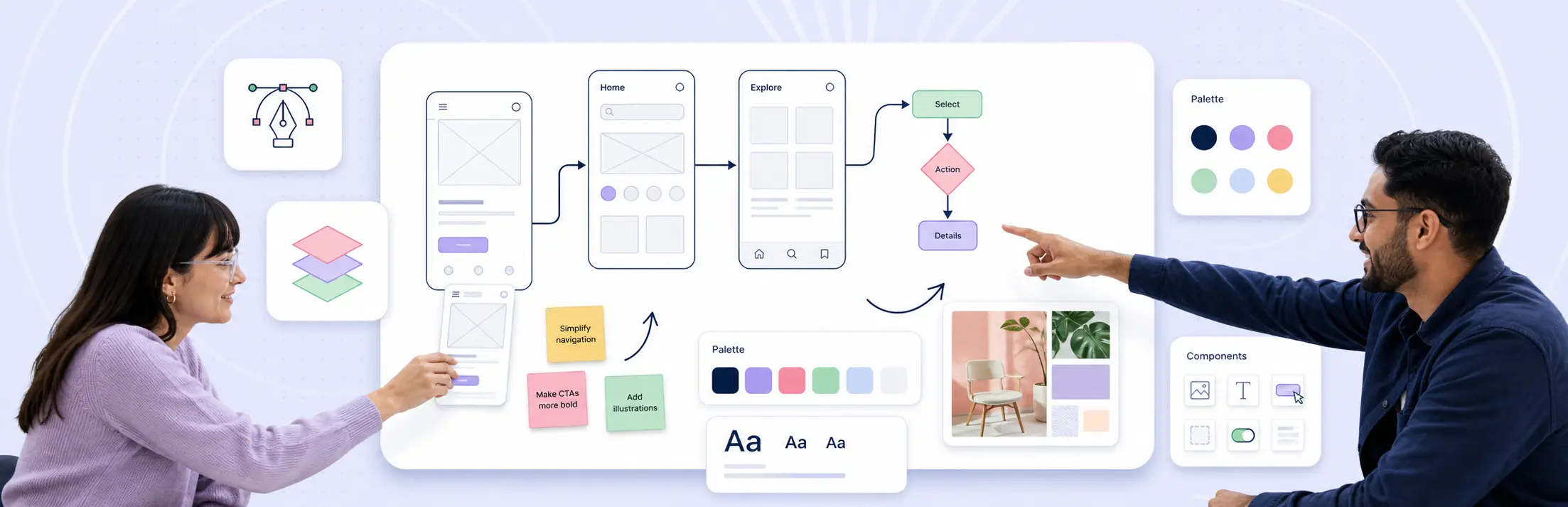
In this stage, the conceptual blueprint transforms into a working model of the product. This tangible prototype can take various forms, including low-fidelity or high-fidelity versions. Using a range of prototyping tools and techniques, you create a functional representation of your product to assess its feasibility, functionality, and design.
Usually, it takes several prototypes to produce a final example of the product. After production, each prototype will undergo testing to ensure that it satisfies the final standards.
The prototyping phase may lead to a minimum viable product (MVP): the smallest usable version that can test important assumptions and deliver value to an initial group of users. An MVP is a learning vehicle, not simply a feature-reduced final product, and it should be designed around a clear hypothesis and measurable feedback.
Imagine you’re developing a project management software application. The minimum viable product (MVP) for this software might include fundamental features like task creation, project organization, and user collaboration capabilities. However, it would not initially include more advanced functionalities like time tracking, detailed reporting, or third-party integrations.
By releasing this MVP, you can get your software into the hands of users sooner and start gathering valuable feedback. As you receive input and understand user needs, you can then prioritize and implement additional features in subsequent updates to make the software more comprehensive and valuable to your users.
Stage 4: Testing and Validation
Testing and validation provide evidence that the product addresses user needs and meets defined quality, safety, and business requirements. The appropriate methods depend on the product and its risks, but common dimensions include:
Performance Testing:
Performance testing is a crucial aspect of ensuring your product functions optimally. It involves subjecting the product to rigorous quality tests, including stress tests, load tests, and environmental tests. Stress tests evaluate the product’s robustness under extreme conditions, simulating peak user loads or resource constraints. Environmental tests assess how the product performs in different environmental conditions, ensuring it remains functional across various situations and locations.
User Acceptance Testing:
User acceptance testing is a pivotal phase that focuses on involving the end-users in the testing process. This step enables real users to interact with the product and provide feedback on its usability, functionality, and overall experience. User acceptance testing helps ensure that the product aligns with user expectations and can effectively address their needs. It often involves creating test scenarios that mimic real-world usage and verifying whether the product meets these requirements.
Industry Compliance:
Regulated products may need to meet industry-specific legal, safety, privacy, accessibility, or quality requirements. Identify the applicable requirements early and include appropriate verification, documentation, and expert review in the development plan. The exact obligations vary by product, market, and jurisdiction.
Stage 5: Production and Launch
The production and launch stage turns a validated concept into a market-ready product. The work differs for physical products, software, and services, but it generally requires coordinated release planning, quality assurance, operational readiness, positioning, pricing, distribution, customer support, and measurement. Clear ownership and handoff criteria help prevent gaps as responsibility moves from development teams to launch and operational teams.
Manufacturing Preparation: The first step in this phase is to prepare for production. It involves setting up the production facilities, procuring necessary equipment, and ensuring the availability of raw materials. Production planning must be precise to meet demand and maintain quality standards. This is where you turn prototypes into actual products, fine-tuning the manufacturing process to optimize efficiency.
Quality Assurance: Quality control is paramount during production. Implementing strict quality assurance processes ensures that each product rolling off the assembly line meets the predetermined quality standards. This step prevents defects and issues that could lead to product recalls or customer dissatisfaction.
Supply Chain Optimization: To ensure smooth production and delivery, supply chain optimization is crucial. It involves coordinating suppliers, manufacturers, and distributors to minimize delays, reduce costs, and maintain efficient inventory management. An optimized supply chain is essential for meeting delivery deadlines and minimizing lead times.
Marketing Strategy: Concurrently, your marketing team should be working on a robust marketing strategy. This strategy should encompass various elements, including identifying your target audience, crafting compelling marketing messages, and selecting the most effective marketing channels. The goal is to create anticipation and generate interest in your product before it even hits the market.
Pricing Strategy: Deciding on the right pricing strategy is a pivotal element of your product’s success. It should be based on a thorough analysis of production costs, market demand, and competition. The chosen pricing strategy should balance profitability and affordability for your target audience.
Distribution Channels: Planning your distribution channels is equally important. Whether you opt for a direct-to-consumer approach, selling through retailers, or a combination, the choice should align with your target market’s preferences. Setting up efficient distribution channels ensures that your product reaches your customers effectively.
Logistics and Inventory Management: Managing the logistics of getting your product to market is a multifaceted task. This includes transportation, warehousing, and inventory management. Efficient logistics are essential for on-time delivery and maintaining an optimal level of inventory to meet demand without overstocking.
Market Entry: The product launch is a significant event that requires careful orchestration. This is the moment when your product steps into the spotlight, and first impressions matter. Leveraging various marketing tactics, you generate awareness and excitement among your target audience, building anticipation for your product’s availability.
Stage 6: Post-Launch Evaluation and Iteration
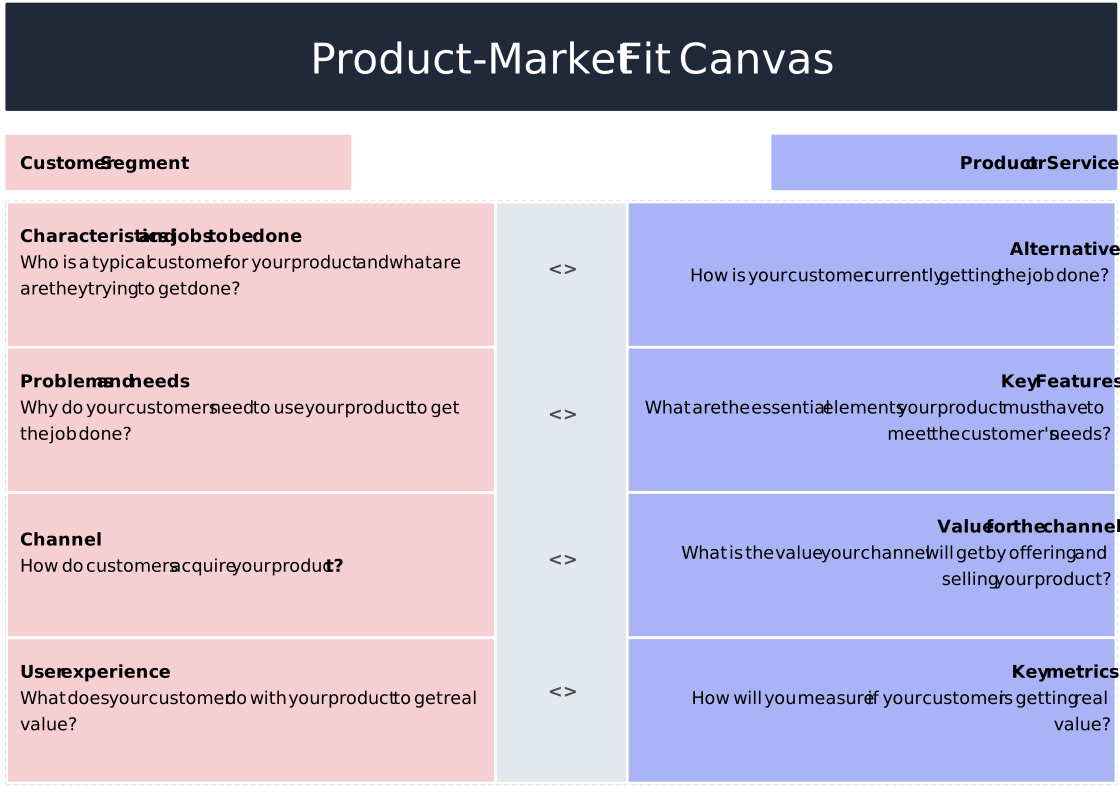
A product’s development does not end at launch. Compare results with the success measures defined earlier, combining quantitative indicators—such as adoption, retention, reliability, revenue, or support volume—with qualitative customer feedback. Select metrics that match the product and its goals rather than relying on a universal KPI set.
Use these findings to prioritize improvements and update the development process itself. Stakeholders can comment on proposed changes, accountable owners can incorporate agreed updates, and version history can help teams revisit how the process changed. Maintaining the process as living documentation keeps decisions, handoffs, and supporting context available for the next iteration.
Tips for Effective Product Development
1. Cross-functional collaboration: Successful product development requires the cooperation of multiple teams, including marketing, design, engineering, and more. Encourage open communication and collaboration to harness the full range of expertise within your organization.
User-Centered Approach: Prioritize the needs and preferences of your target audience. Collect user feedback, conduct usability testing, and iterate your product based on real user experiences. This approach ensures that your product resonates with your intended users.
Agile Methodology: Adopt agile practices to remain flexible and responsive to changes throughout the development process. Regularly review and adjust your product based on customer feedback and evolving market trends.
Prototyping and Testing: Develop prototypes to validate your ideas and concepts. Test these prototypes rigorously to identify potential issues early in the process, reducing development costs and risks.
Scalable Infrastructure: Plan for scalability from the start. As your product gains traction, it should easily accommodate increased user loads and feature enhancements. Scalability prevents technical bottlenecks and supports long-term growth.
Understanding the stages of product development gives cross-functional teams a shared path from opportunity discovery to post-launch learning. Treat the cycle as an adaptable framework rather than a rigid sequence: define ownership, make handoffs explicit, preserve the evidence behind decisions, and review the process as new information emerges. This turns product development into a repeatable learning system and helps teams improve both the product and the way they build it.