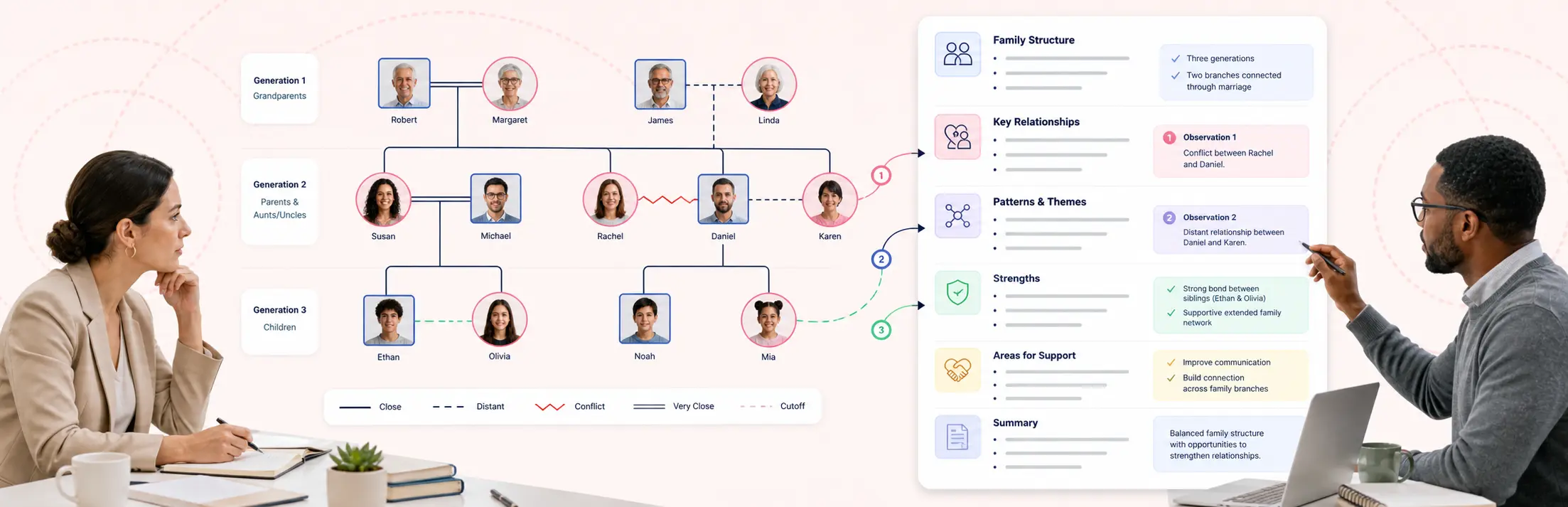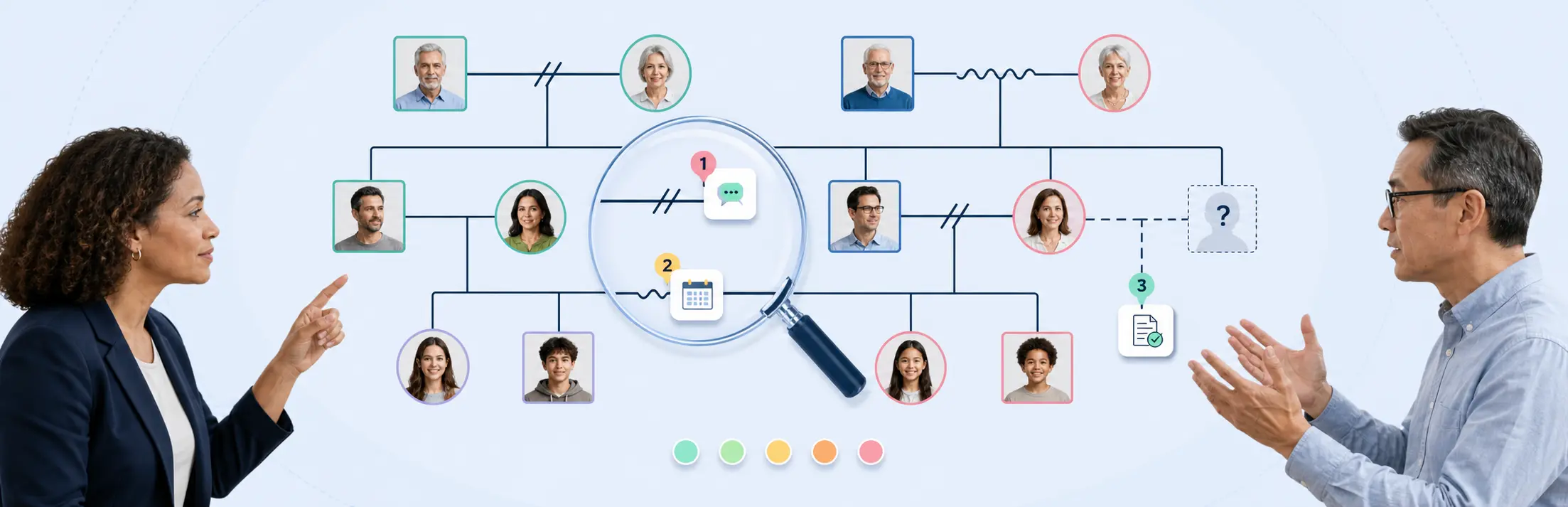
In social work practice, a genogram helps practitioners move beyond a basic family tree and see the patterns surrounding a client’s life more clearly. It can bring family structure, caregiving roles, conflict, trauma, mental health history, and support systems into one visual assessment tool.
This guide explains what a genogram is in social work, why it matters in practice, which symbols are commonly used, and how social workers can turn that information into better-informed interventions.
What Is a Genogram in Social Work?
A genogram in social work is a visual assessment tool that maps family relationships, emotional connections, and important patterns across generations. It helps social workers organize information about household structure, caregiving, trauma, health concerns, conflict, and resilience in a format that is easier to discuss and review.
Why Genograms Matter in Social Work Practice
- Understanding Family History: genograms help social workers explore relationships, past experiences, and cultural influences that may be shaping a client’s current situation.
- Identifying Patterns and Dynamics: They make reported patterns in areas such as substance use, conflict, estrangement, mental health, and caregiving easier to compare across generations.
- Strengthening Intervention Planning: A visual map helps practitioners design supports that fit the family’s actual structure, risks, and strengths.
- Improving Client Engagement: A shared visual may make complex family information easier to discuss and correct collaboratively.
- Supporting Reflection and Empathy: Genograms can support discussion about how clients understand the influence of family history on identity, coping, and current stressors.
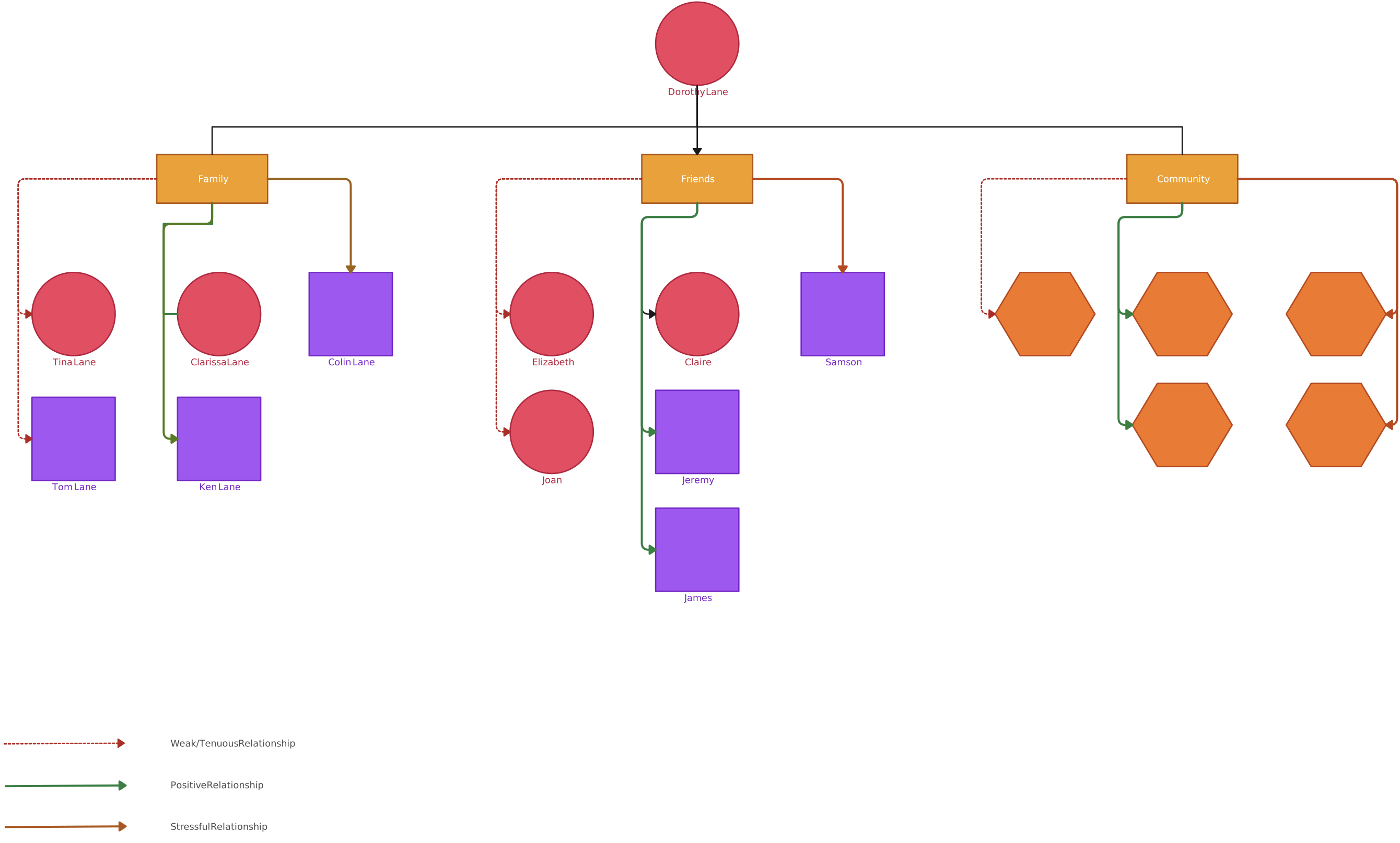

How to Use a Genogram in a Social Work Assessment
A social work assessment genogram should help answer a defined practice question. It can clarify who is involved, how people are connected, what has changed, where risks may sit, and which strengths can support the plan. It should organize evidence without turning a visual pattern into a diagnosis.
Start by agreeing on the purpose with the client. The assessment might support placement stability, family reunification, safeguarding, discharge planning, caregiver capacity, or access to services. Explain what will be recorded, how the diagram will be used, who can access it, and when it will be reviewed.
What to Include in an Assessment Genogram
| Assessment layer | What to record | What it helps clarify |
|---|---|---|
| Family structure | Household members, parents, partners, siblings, children, and significant non-biological kin | Who is part of the family system |
| Legal and care relationships | Marriage, separation, adoption, foster care, guardianship, and kinship care | Who has formal or practical responsibility |
| Relationship quality | Support, closeness, conflict, estrangement, cutoff, or violence when safe and relevant | How relationships affect safety and care |
| Significant events | Births, deaths, moves, migration, placement changes, losses, and major transitions | Timing and possible turning points |
| Health and wellbeing | Relevant physical health, mental health, disability, and substance use | Needs, patterns, and service coordination |
| Risks and concerns | Harm, neglect, instability, isolation, coercion, and unmet needs | Areas requiring direct assessment or action |
| Strengths and protective factors | Stable relationships, caregiving capacity, recovery, cultural resources, and practical support | Resources that can support the plan |
| Evidence status | Client report, record, observation, professional report, or unconfirmed account | What is known and how it is known |
Separate facts from interpretations. “Two missed school weeks recorded this term” is an observation. “The caregiver is disengaged” is an interpretation that needs context and supporting evidence.
Genogram vs. Ecomap in Social Work Assessment
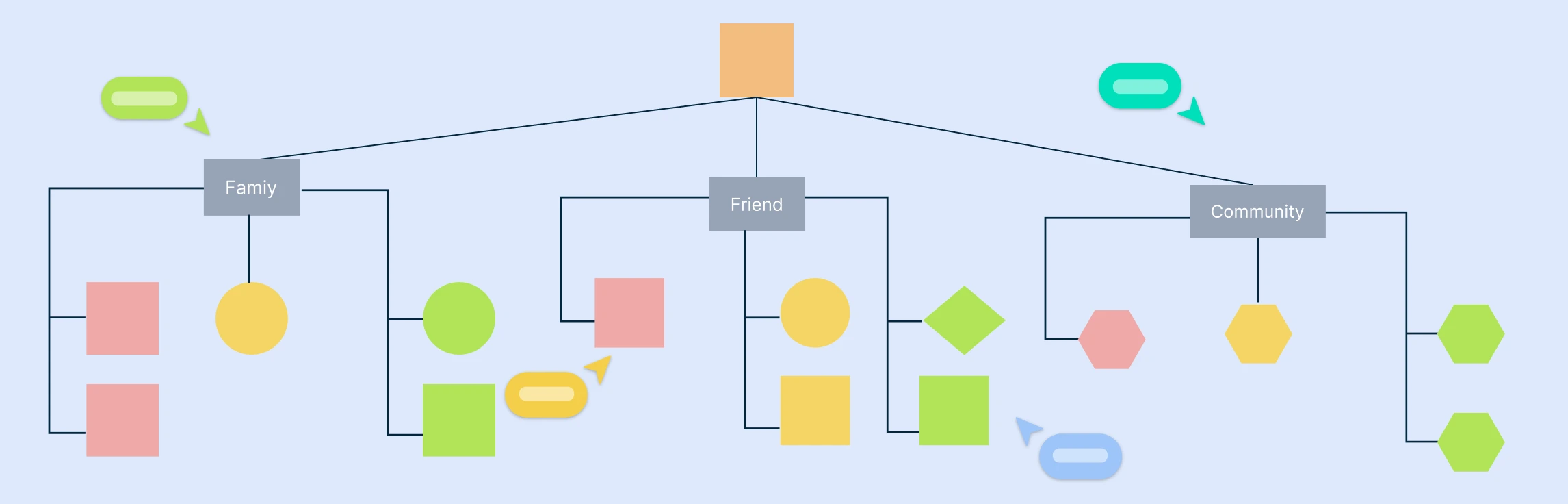
A genogram maps the family system across generations. An ecomap maps the person or household’s current relationships with schools, services, work, housing, community groups, and other external systems.
| Assessment question | Genogram | Ecomap |
|---|---|---|
| Who belongs to the family system? | Yes | Limited |
| What patterns recur across generations? | Yes | No |
| Which services and community supports are involved now? | Limited | Yes |
| Where is support strong, weak, or stressful? | Within the family | Across external systems |
| Which agencies need coordination? | Limited | Yes |
Use both when family history and the present service environment affect the plan. A genogram may reveal repeated caregiving disruption. An ecomap may show that the current caregiver has a strong relationship with the school but limited transport and respite support.
An Assessment-Focused Workflow
- Define the decision. State the question the assessment must support before collecting family history.
- Map the current household. Add legal relationships and the people who provide care in practice, even when those groups differ.
- Extend across relevant generations. Three generations is a useful starting point, not a rigid requirement. Mark unknown or unconfirmed information clearly.
- Add relationships and significant events. Include approximate dates so reviewers can connect changes in the family system with the presenting concern.
- Record risks and strengths together. A risk-only map can distort the assessment and hide resources that make an intervention workable.
- Add an ecomap when needed. Map services and informal support rather than crowding external systems into the genogram.
- Review the diagrams with the client. Ask what is inaccurate, missing, overemphasized, or unsafe to display.
- Convert the map into findings. Summarize the current situation, evidence, hypotheses, risks, strengths, actions, and review date.
Where family members provide conflicting accounts, record the source and the difference. Do not force a single version when the disagreement is relevant to the assessment.
Example: From Family Map to Assessment Plan
Consider a 14-year-old referred after repeated school absence. The genogram shows that the young person lives with an aunt, has intermittent contact with a parent, and relies on an older sibling for transport. Two earlier caregiving changes followed bereavements. The ecomap shows a strong relationship with a school counselor, weak contact with primary care, and no current respite support for the aunt.
The diagrams do not establish why attendance dropped. They create focused questions and actions: ask about transport, sleep, health, safety, and school experience; confirm legal and practical caregiving roles; coordinate with the school using appropriate consent; and explore respite, transport, bereavement, or health support based on confirmed needs. The school relationship and sibling support should also be recorded as protective factors.
Consent, Privacy, and Documentation
Genograms can contain sensitive information about people who are not clients. Apply data minimization. Record what the assessment needs rather than every detail disclosed.
The NASW Code of Ethics informed-consent standard says clients should receive clear information about the purpose, risks, alternatives, right to refuse or withdraw consent, and relevant time frame. The NASW Standards for Technology in Social Work Practice also address how electronic information is gathered, used, accessed, stored, retained, and secured.
Date each version. Distinguish client report, professional observation, verified record, and unconfirmed account. Restrict access according to agency policy and applicable law, and avoid placing identifiable information in unapproved tools.
Social Work Assessment Genogram Checklist
Before using the genogram in a case review, confirm that it:
- answers a defined assessment question;
- distinguishes facts, reported information, observations, and hypotheses;
- includes relevant risks and protective factors;
- reflects the client’s corrections and perspective;
- uses consistent symbols and a clear legend;
- includes an ecomap when external systems affect the plan;
- records consent, access, sharing, and confidentiality considerations;
- has a date, version, author, and next review point; and
- leads to specific actions rather than standing alone as a picture.
Social Work Genogram Symbols
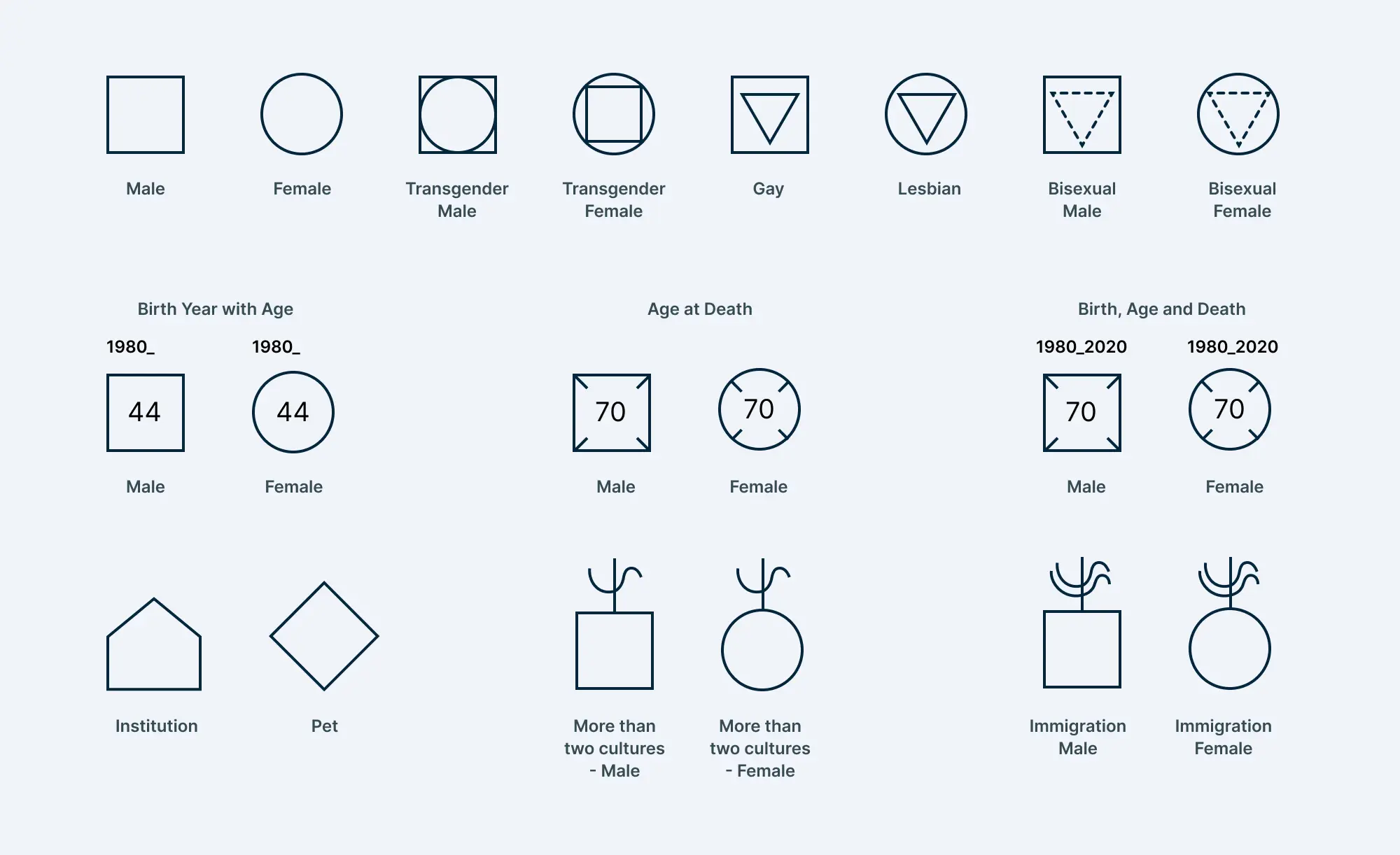
Genograms in social work use a standardized visual language. The symbols below help practitioners represent family structure, relationship status, emotional dynamics, and health-related context clearly.
Basic Genogram Symbols
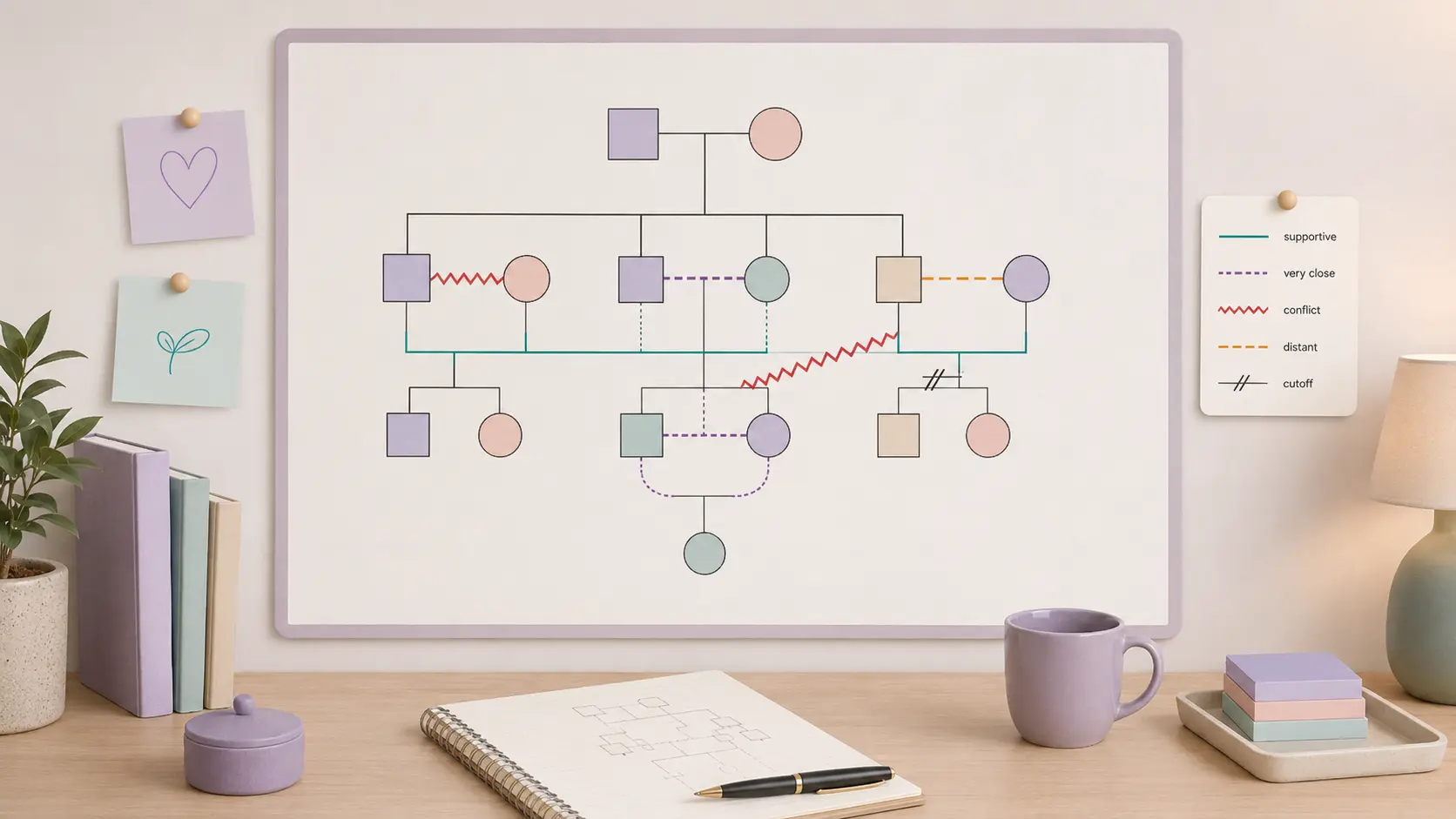
Males are represented by squares, and females by circles.
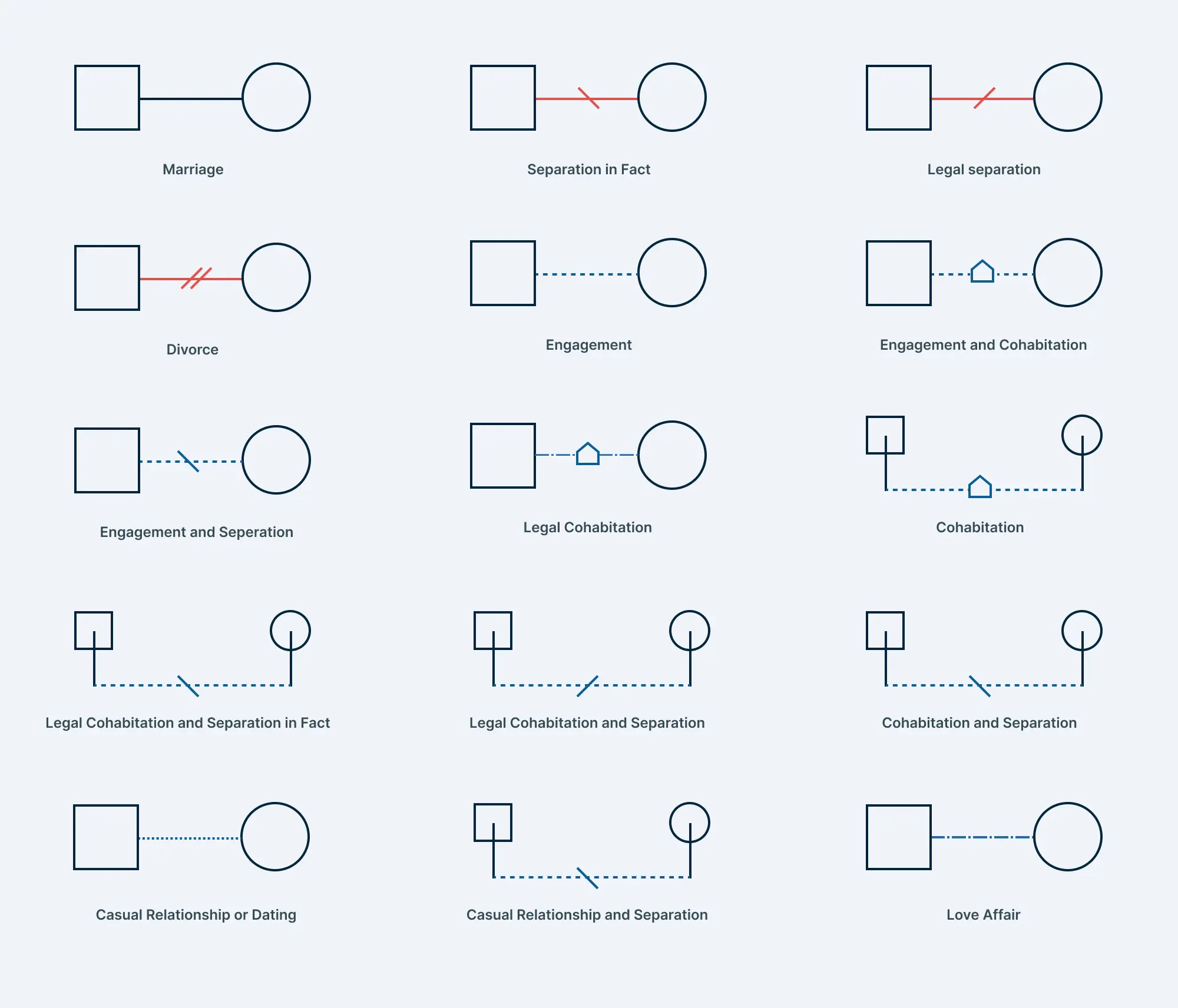
Marital Status Relationship Symbols
A solid line connects married couples, while a double slash through the line indicates divorce. Other types of relationships are also represented through genogram symbols.
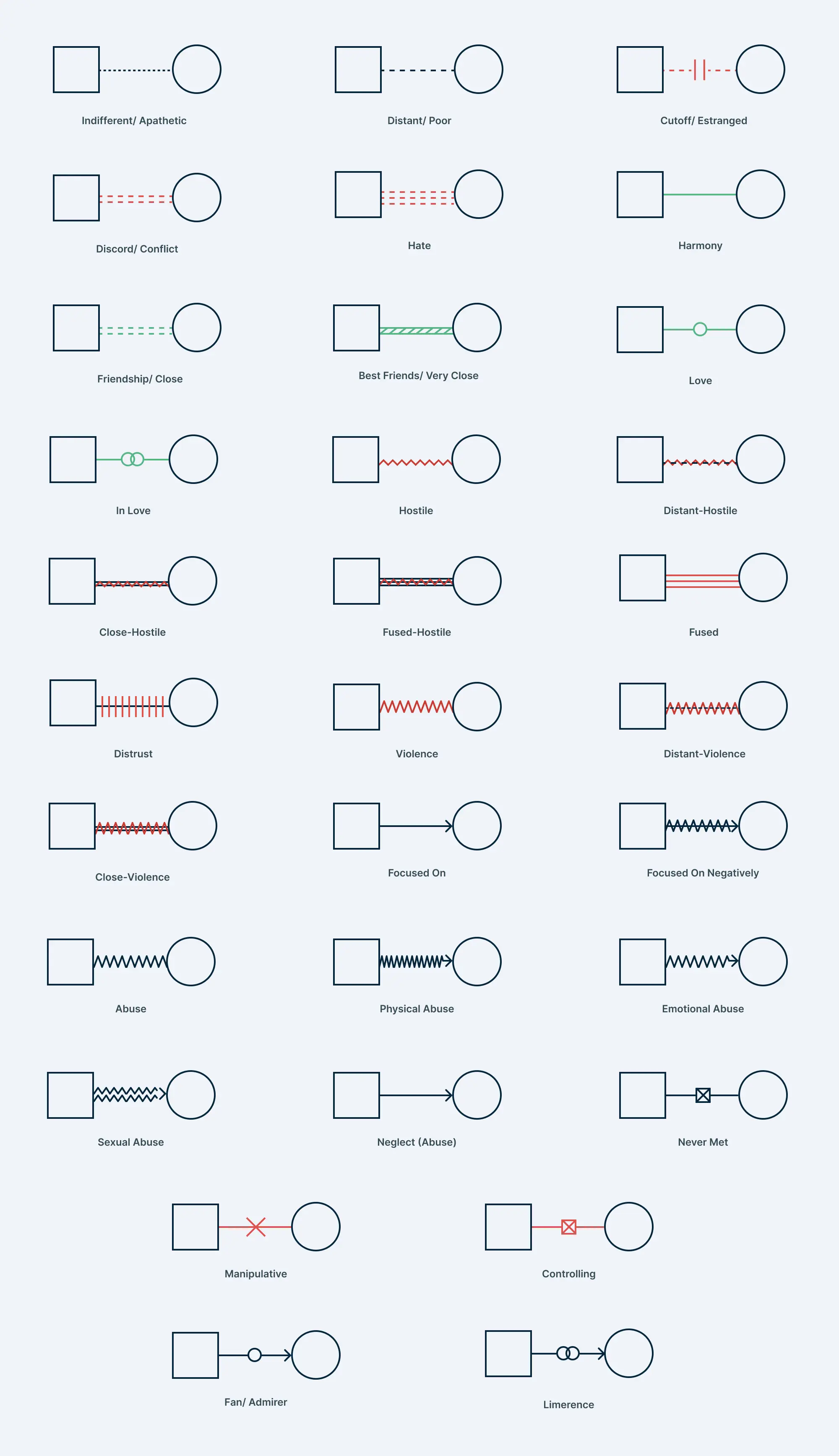
Emotional Relationship Symbols
Different types of emotional bonds (e.g., close, distant, conflictual) are represented using various dashed or wavy lines.
Genogram Symbols for Medical & Psychological Conditions
Symbols can indicate health issues like depression, addiction, or diseases.
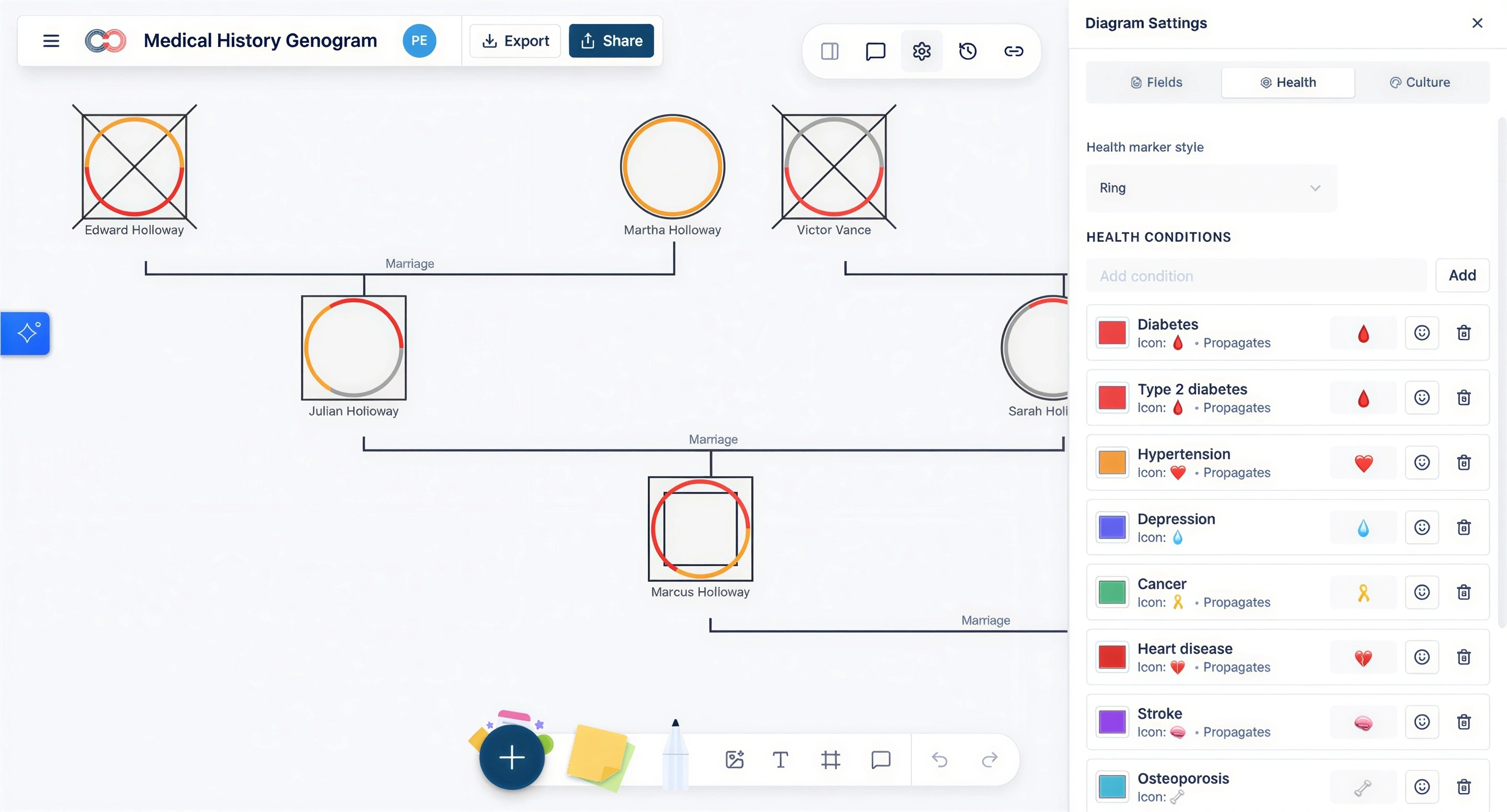
Creately includes a large library of relationship and status symbols for genograms. To learn these symbols in more detail, read our guide on genogram symbols, which covers 70+ commonly used symbols.
How to Create a Social Work Genogram with Creately
Creating a genogram is a transformative process in social work, turning scattered family histories into a structured, clinical data map. By following these steps, you can move beyond simple “family trees” to organize family information and explore possible patterns in relationships, caregiving, health, adversity, and support across generations.
Note: Approach the creation process with clinical sensitivity and accuracy. Always respect client confidentiality and ensure you have informed consent before documenting sensitive family information.
Step 01. Gather Family Information
Interview Clients and Family Members
To build an accurate genogram, start with open and empathetic interviews. Engage in conversations that explore at least three generations of family history. Use active listening to capture not just names and dates, but record how family members describe communication, closeness, conflict, caregiving, boundaries, and support.
Collect Key Clinical Data
During the intake, collect standard data such as ages and genders, but look deeper. Inquire about:
- Legal & Biological Status: Adoptions, foster care arrangements, and finalized vs. pending divorces.
- Medical & Mental Health History: Document chronic illnesses, substance abuse patterns, and neurodivergence.
- Relational Dynamics: Identify emotional cutoffs, fused relationships, or high-conflict triangles.
Step 02. Build the Genogram in Real-Time
Use Text-to-Genogram for a Starting Draft
Instead of drafting everything manually after a session, you can use AI Text-to-Genogram in Creately to turn intake notes or interview transcripts into a starting family structure. This can save time when you need an initial draft that you can then review and refine.
Organize with Standardized Symbols
Once the foundation is set, use a standardized library of relationship and status types. Following McGoldrick/Gerson standards helps keep the diagram readable for other clinicians and consistent in documentation.
- Quick-Add Shortcuts: Use keyboard shortcuts to build out the tree more efficiently during conversation.
- Centralize Data: Use the Data Panel to attach files, sensitive notes, or trauma history directly to specific family nodes, keeping your case file organized.
Secure Collaboration
Social work often involves working with legal or medical teams. Share your genogram via secure, secure links with role-based permissions (Viewer, Editor, or Moderator) to ensure sensitive data is only accessible to authorized stakeholders.
Step 03. Analyze through Layered Views
Toggle Clinical Lenses
A genogram can be reviewed from different angles depending on your current assessment goal. Use layered views to focus on the information that matters most:
- Generic View: This is your foundational layer. It provides a clean, high-level overview of the family structure, including names, ages, and basic connections. It is ideal for initial case presentations or when you need a clear “big picture” of the family tree without the clutter of detailed clinical data.
- Cultural View: Social work requires understanding the family within its broader environment. This view highlights cultural background, migration history, religious affiliations, and significant community influences. It helps clinicians identify cultural strengths, potential conflicts with societal norms, and the impact of the family’s heritage on their current dynamics.
- Health View: This layer focuses on physical and mental well-being. It instantly highlights hereditary risks, chronic illnesses, causes of death, and patterns of substance abuse across three or more generations. By isolating these variables, you can more easily spot recurring medical trends that may be impacting the family’s current functioning.
Step 04. Professional Documentation
The final stage of the workflow moves beyond the diagram itself. Once your genogram is complete, you can use the report generation feature to turn it into a structured narrative. Creately also lets you export genogram data into text-based reports for different professional scenarios:
- Clinical Case File: A comprehensive, multi-section report designed for formal case reviews and clinical documentation.
- Health & Risk Summary: An overview highlighting hereditary family patterns and risk tables, accompanied by a diagram with health markers.
- Legal/Forensic Report: A structured document focusing on family environments, conflict-based ties, and a chronology of events suitable for court submission.
- Relationship Dynamics Summary: A deep dive into the “vibe” of the family, including a relationship matrix with tone labels and identified triangle patterns.
- Genealogical & Historical Report: A lineage-focused document capturing life events, education, and occupation patterns over generations.
- Session/Progress Snapshot: A concise therapy-oriented document highlighting changes since the last session and current interventions.
- Anonymized/Teaching Export: A privacy-first export that uses pseudonyms (e.g., P1, P2) and strips sensitive notes, perfect for training and academic research.
- Custom/Analytical Export: A versioned data document of individuals and relationships, optimized for research or integration with other clinical tools.
For a more in-depth lesson in making genograms, check our genogram tutorial and learn how to make one in minutes.
Social Work Genogram Examples
Let’s explore a few real-world case examples that highlight the effectiveness of genograms in social work practice.
School Setting
A genogram can help a school social worker understand the student’s household, caregivers, important family relationships, recent transitions, and sources of support. It may raise questions about transport, bereavement, housing changes, caregiving responsibilities, or communication between home and school. These patterns should guide further assessment rather than be treated as explanations on their own.
Hospital and Discharge Planning
A genogram can clarify who provides care, who makes decisions, which relationships are supportive or strained, and whether the patient has experienced recent changes in the household. Used with an ecomap, it can help the social worker assess service involvement, transport, housing, respite, and community support before discharge.
Relationship Counseling
In couple or family practice, a genogram can help clients compare family-of-origin experiences, communication patterns, caregiving expectations, conflict, and boundaries. These observations can inform therapeutic questions but should not be treated as proof that family history caused the current difficulty.
Social Work Genogram Templates Made with Creately
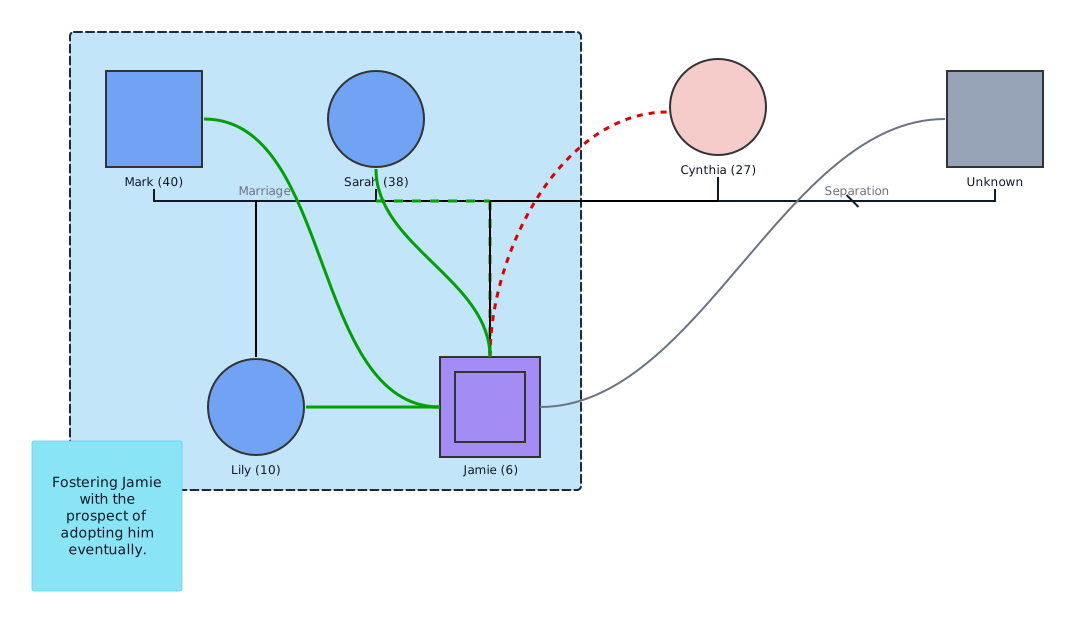
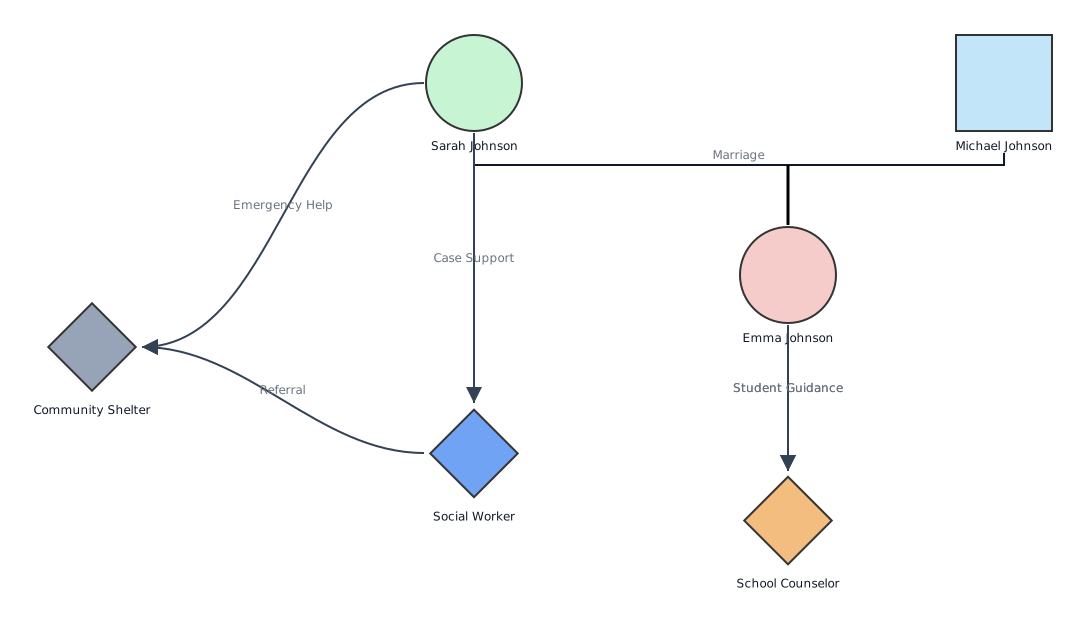
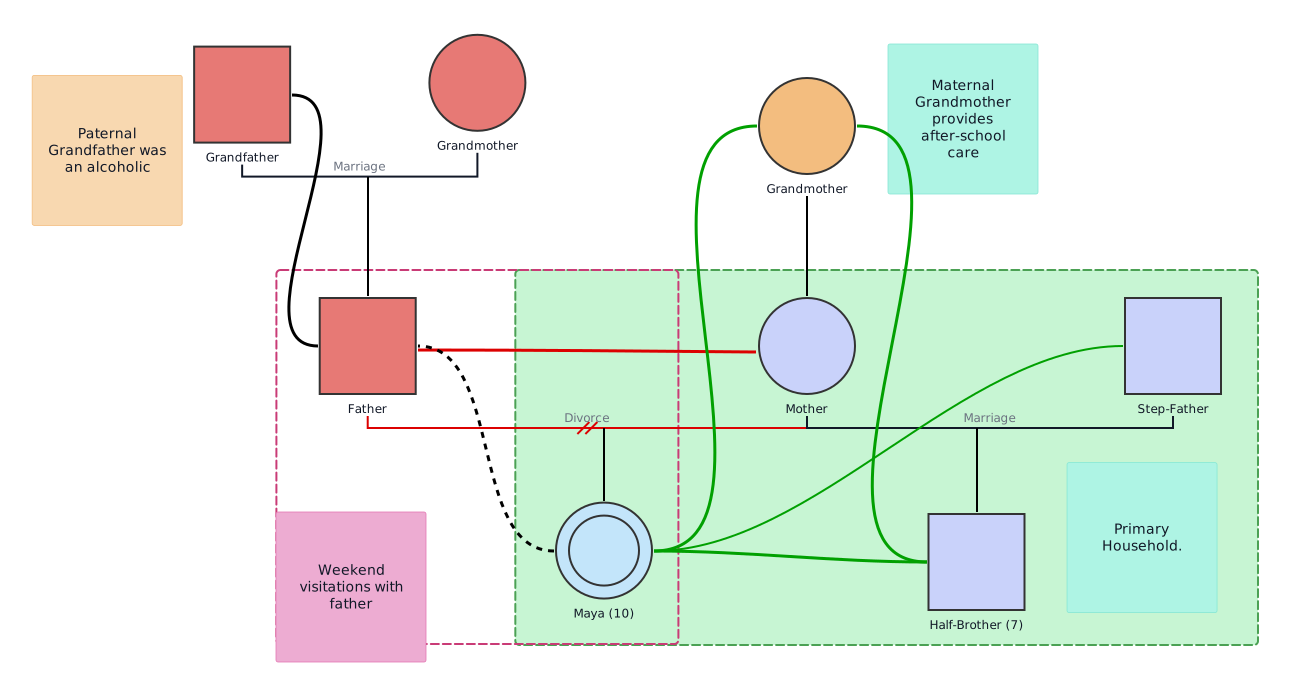
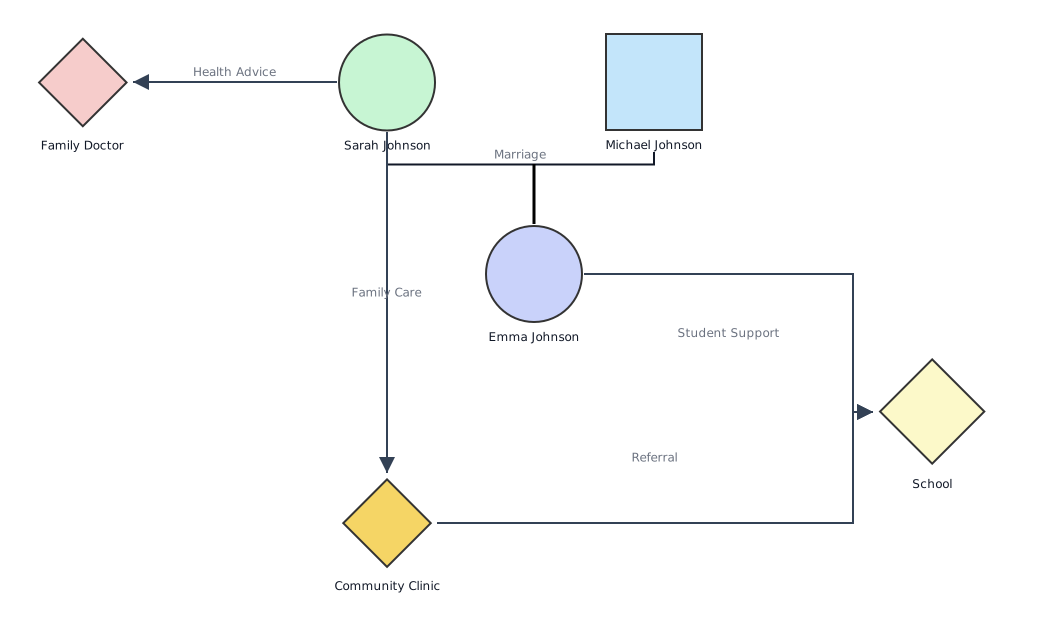
The great thing about using Creately for making genograms in social work is the large template library that becomes available to you. Users can browse, select and customize these ready-made templates to make their job easier. Here are some more genogram templates to get started with.


Helpful Resources
Discover everything you need to know about genograms, from what they are, how to create a genogram, to how to understand what they mean.
Explore our collection of genogram templates.
Learn how different types of genograms can help visualize important aspects of life.
FAQs About Genograms in Social Work Practice
What are the ethical considerations that you should be aware of when creating genograms?
What is the difference between a genogram and a family tree?
How can you use Creately to create your social work genogram?
What are the different types of genograms in social work?
Resources
Butler, J.F. (2008). The Family Diagram and Genogram: Comparisons and Contrasts. The American Journal of Family Therapy, 36(3), pp.169–180. doi:https://doi.org/10.1080/01926180701291055.
Majhi, G., Reddy, S. and Muralidhar, D. (2018). The use of family genogram in psychiatric social work practice. Open Journal of Psychiatry & Allied Sciences, [online] 9(2), pp.98–102. doi:https://doi.org/10.5958/2394-2061.2018.00034.4.
Rempel, G.R., Neufeld, A. and Kushner, K.E. (2007). Interactive Use of Genograms and Ecomaps in Family Caregiving Research. Journal of Family Nursing, 13(4), pp.403–419. doi:https://doi.org/10.1177/1074840707307917.